
Historical report · observations from September 15, 2026
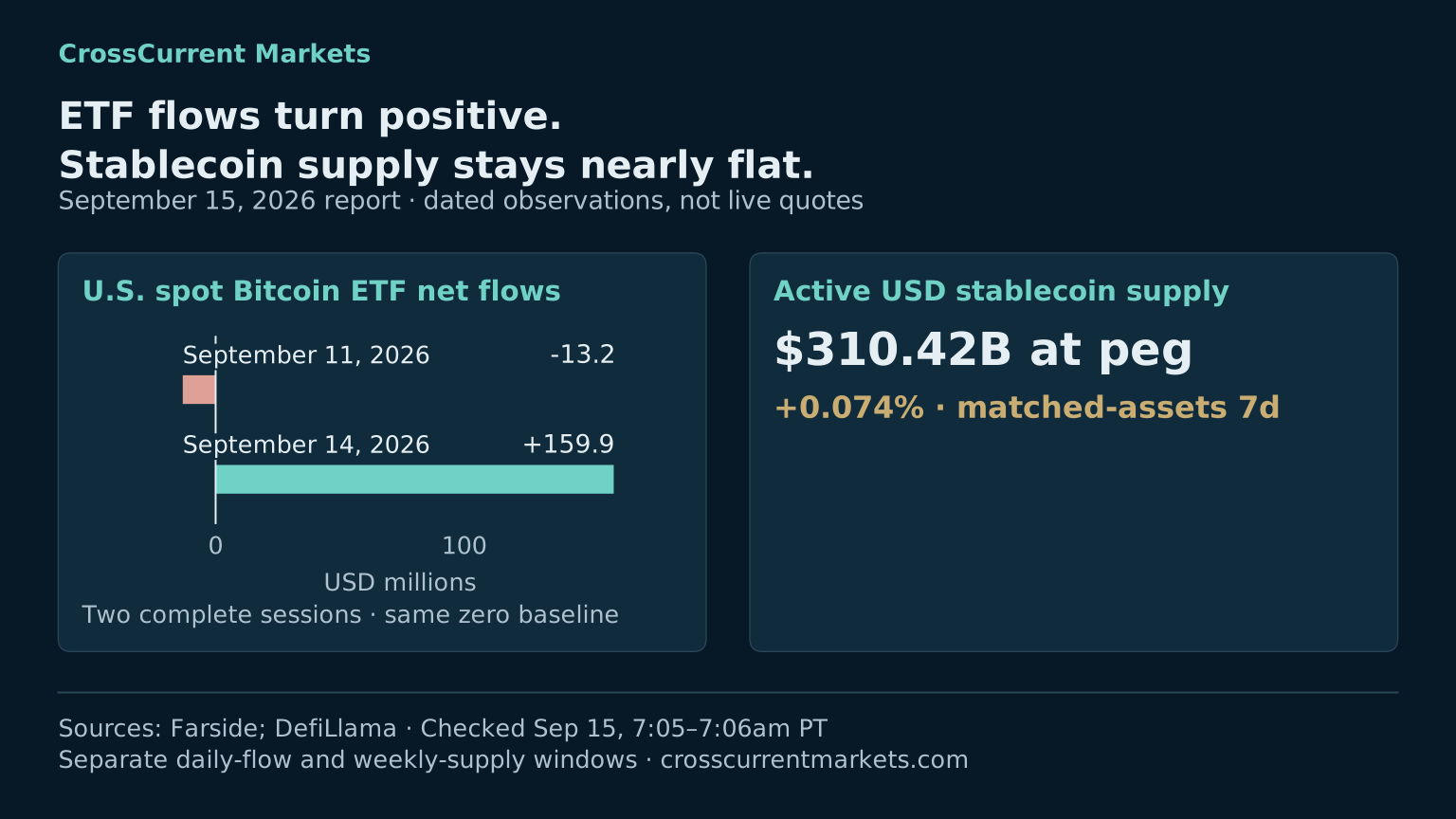
What changed ETF flows turned positive; BTC fell and implied volatility rose.
Why BTC Fund demand improved, but the wider liquidity and macro evidence remains mixed.
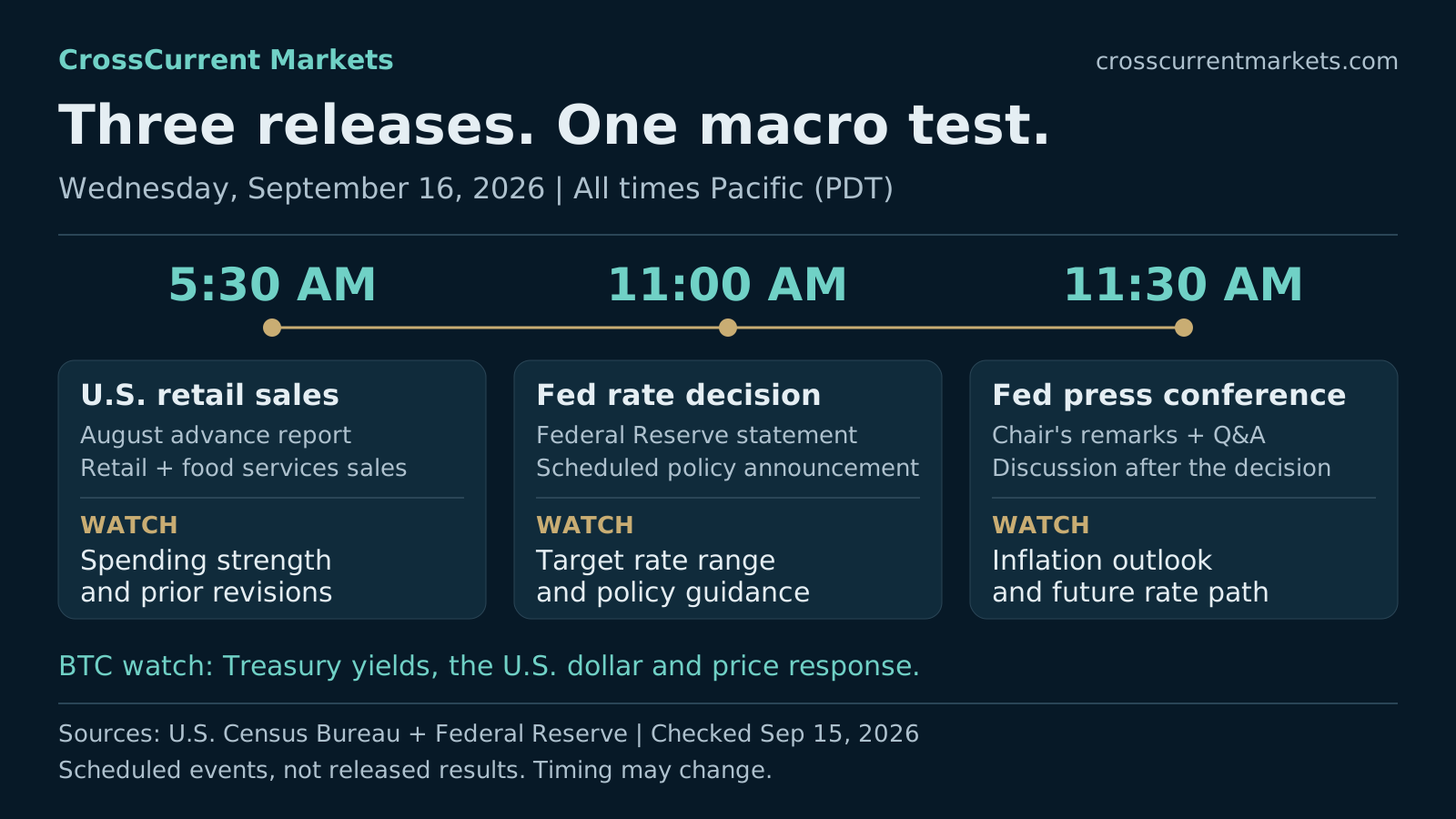
What to watch Subsequent ETF sessions, U.S. retail sales and the September 16 Fed decision.
Read the full analysis and sources
Bitcoin was $76,381.80, down 2.70% over 24 hours, in the Coinbase Exchange snapshot checked at 7:05 a.m. Pacific. U.S. spot Bitcoin ETF flows had improved in the latest completed session, while stablecoin supply was nearly flat over seven days and options-implied volatility had risen.
Our assessment: the fund-demand picture improved, but the wider evidence remains mixed ahead of the Federal Reserve decision. This is a dated morning report based on public observations. The numbers retain their original check times and measurement periods; they are not live quotes or a price forecast.
The morning evidence
| Measure | Latest observation | Comparison and timing |
|---|---|---|
| Bitcoin | $76,381.80 | −2.70% over the rolling 24 hours; Coinbase checked September 15, 7:05 a.m. PT |
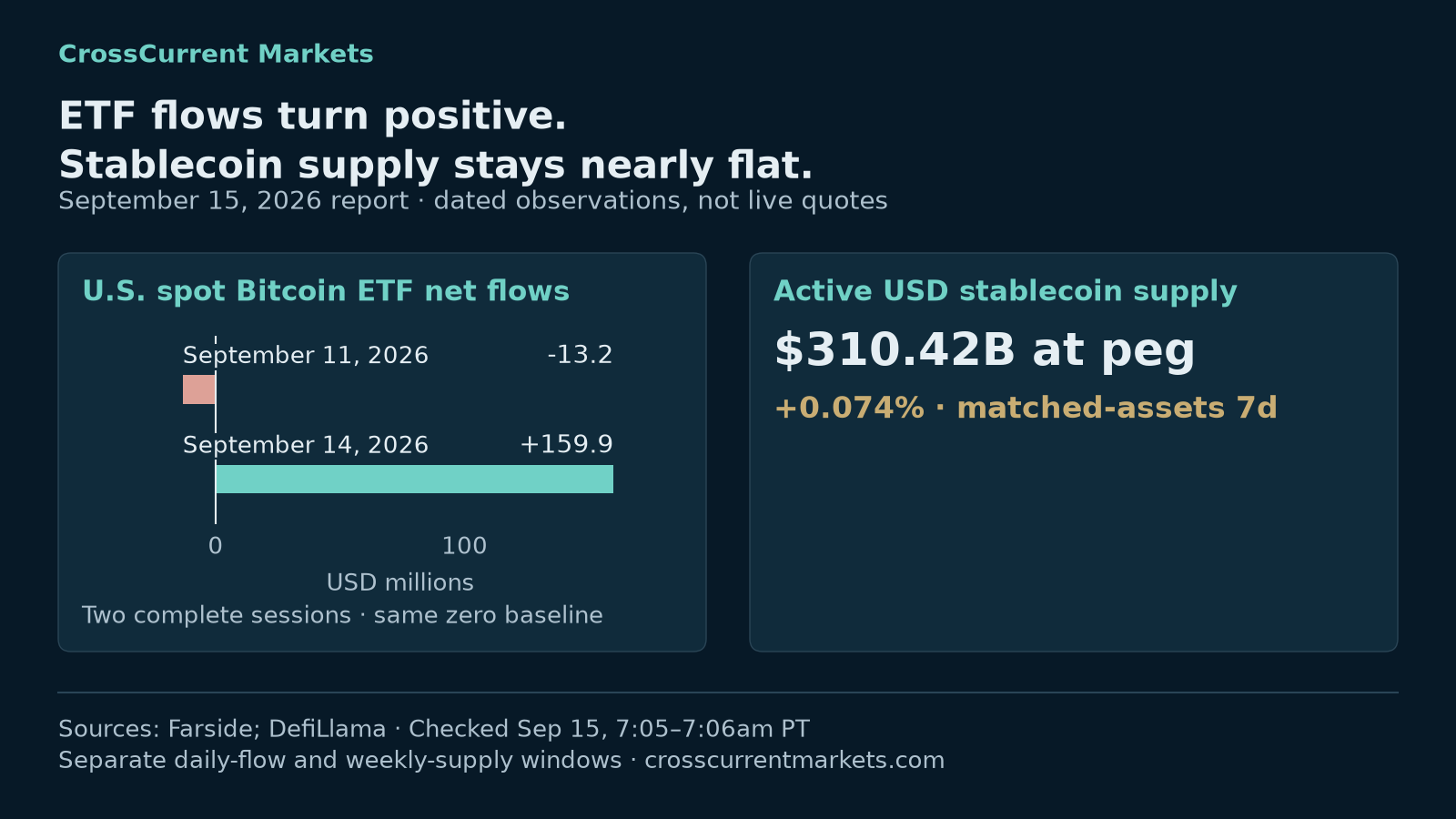
| U.S. spot BTC ETF flows | +$159.9 million | September 14 session; September 11 was −$13.2 million |
| Active USD stablecoin supply | $310.42 billion at peg | +0.074% over seven days for matched assets; September 15 check |
| BTC options-implied volatility | DVOL 40.42 | 37.90 one day earlier; completed 6–7 a.m. PT hours |
| Fed target range | 3.50–3.75% | September 14 effective-rate data; September 16 decision still pending |
| Treasury two-year yield | 4.63% | September 11 observation versus 4.56% on September 10 |
Sources: Coinbase, Farside, DefiLlama, Deribit, New York Fed and Federal Reserve H.15. These observations use different clocks and cannot be combined into a single daily return or liquidity total.
ETF demand improved in the latest complete session
Farside reported a $159.9 million net inflow for September 14, following a $13.2 million outflow on September 11. All 12 fund entries were populated for those sessions. September 15 remained unreported in the morning check; a displayed total beside missing entries is not a completed zero-flow day. Farside's daily table.
The improvement matters because it shows demand through one route into Bitcoin exposure. It does not reveal every investor's identity, motive or holding period, and one positive session does not establish a persistent trend. Farside is a data compiler; its figures may be revised.
Bitcoin's lower rolling price reading does not invalidate that observation. The ETF session and the quote's rolling 24-hour window are not identical. Other investors, trading venues and changing expectations can affect the price at the same time. We examine this distinction in why Bitcoin can fall while ETF inflows rise.
Stablecoin liquidity remained nearly flat
Active USD stablecoin circulating supply was $310.42 billion, valued at the tokens' dollar pegs. The matched-assets seven-day increase was 0.074%. That is a small change and gives limited evidence of a broad expansion in this part of crypto liquidity. DefiLlama data.
Supply measures outstanding units. It does not show how much investors intend to spend on Bitcoin. Stablecoins also serve trading, payments, collateral and other uses, so more supply is not automatically a BTC purchase signal. The ETF flow and stablecoin panels describe separate measurements.
For this weekly calculation, 307 of 312 active assets had comparable balances, covering 99.986% of current supply. The headline total includes all active assets; the percentage compares the same assets across the two periods. Yesterday's rolling week and matched membership were different, so the change between the two reported weekly percentages is not a clean measure of one day's issuance.
Funding and global liquidity: separate the channels
September 14's secured overnight financing rate, SOFR, was 3.62%, and the effective federal funds rate was 3.63%. Both were unchanged from September 11. The Fed target bounds remained 3.50–3.75% in that observation. New York Fed rates.
The completed overnight reverse-repo operation fell to $1.420 billion from $5.255 billion in the prior session. This is one money-market facility, not a measurement of funds entering Bitcoin. New York Fed operations.
The September 10 Fed balance-sheet release, covering the week ended September 9, showed average bank reserves rising and the average Treasury General Account balance falling. That release was already available in the prior report. We do not present the same weekly observation as a new daily injection. The next scheduled H.4.1 release is September 17. Federal Reserve balance sheet.
Global credit measures also need their own scope and release dates. The BIS material available during this check did not establish a consistent new-vintage global liquidity reading, so this report makes no new claim about a global liquidity aggregate. Domestic money growth, cross-border credit and dollar funding are related research subjects, not interchangeable totals. BIS indicators.
Rates, the dollar and credit offer competing evidence
The Fed's latest H.15 table showed the two-year Treasury yield at 4.63% on September 11, up seven basis points from September 10. The ten-year yield was 4.96%. These are dated Friday observations, not Tuesday's live bond prices. Federal Reserve H.15.
The broad dollar index rose to 118.2126 from 118.0787 across the same observation dates. This is the Fed's broad index, not DXY. Our interpretation is that higher yields and a firmer dollar can make financial risk less attractive, but those observations alone cannot explain a particular intraday Bitcoin move. Federal Reserve H.10.
Credit provides contrary evidence. The ICE BofA high-yield option-adjusted spread was 2.65% on September 11, down from 2.70% on September 10. A narrower spread does not fit a uniformly worsening financing picture. It is also not a complete diagnosis of financial stability. ICE BofA series via FRED.
Private-credit evidence updates much less frequently. The Fed's May Financial Stability Report discussed redemption pressures and risks to credit availability, alongside mitigating factors. That older assessment cannot establish today's private-credit stress level. Federal Reserve financial stability report.
Market structure: more expected movement, no direction signal
Deribit's BTC DVOL index closed the 6–7 a.m. PT hour at 40.42, compared with 37.90 in the corresponding completed hour a day earlier. DVOL describes 30-day annualized implied volatility. Its rise means greater movement was priced into options; it does not predict whether Bitcoin will rise or fall. The partial hour after 7 a.m. was excluded. Deribit observations.
CoinLore's tracked-market snapshot put Bitcoin dominance at 60.85%. A market-cap share can change through relative prices or changes in the tracked universe. It does not directly identify capital moving into BTC. CoinLore.
Deribit's Bitcoin perpetual-futures open interest was lower than in the prior morning snapshot. This covers one venue and contract, and a dollar-denominated value changes with price as well as positioning. We do not extend it into an estimate of total market leverage. Some on-chain fields failed consistency checks and were excluded, rather than interpreted as zero economic activity. Deribit contract data.
Global macro: China data and regional policy
China's August release showed industrial value added rising 5.2% year on year in real terms, while consumer-goods retail sales rose 0.4% in nominal terms. These are different measures and should not be directly subtracted. Our reading is uneven growth, not a direct measure of money entering crypto. The release arrived at 7 p.m. Pacific on September 14. National Bureau of Statistics.
China's August-end M2 money stock grew 7.5% year on year; aggregate financing stock grew 7.2%. The PBOC report became accessible to this research check today, but its September 14 release was not new since yesterday's morning report. Domestic financing growth is not equivalent to a verified global liquidity expansion. People's Bank of China.
The ECB (European Central Bank) announced a 25-basis-point increase on September 10, taking its deposit rate to 2.50% effective September 16. It is an announced regional tightening step, not a new Fed increase or a decision made today. ECB decision.
Japan's July 31 policy guideline kept the overnight call-rate target around 1.0%, with the next policy meeting scheduled for September 17–18. The Bank of Korea raised its Base Rate from 2.75% to 3.00% on August 27. The dates and jurisdictions matter; neither decision establishes one uniform Asian policy stance. Bank of Japan, Bank of Korea.
Capital rotation and regulation
The Nasdaq-100 closed September 14 at 29,127.16, down approximately 0.82% from September 11. That is a fixed equity-session comparison; the BTC quote uses a rolling window. Without aligned periods and actual flow evidence, we cannot infer that capital moved between technology shares and Bitcoin. No verified aggregate measure of AI investment drawing money out of BTC was established in this check. Nasdaq-100 via FRED.
The SEC and CFTC lists inspected did not identify a new September 15 crypto-specific item by the report's cutoff. That is a limit of the reviewed sources, not a claim that no regulatory developments occurred worldwide. Proposals, approvals and effective rules remain distinct stages. SEC, CFTC.
What to watch on September 16
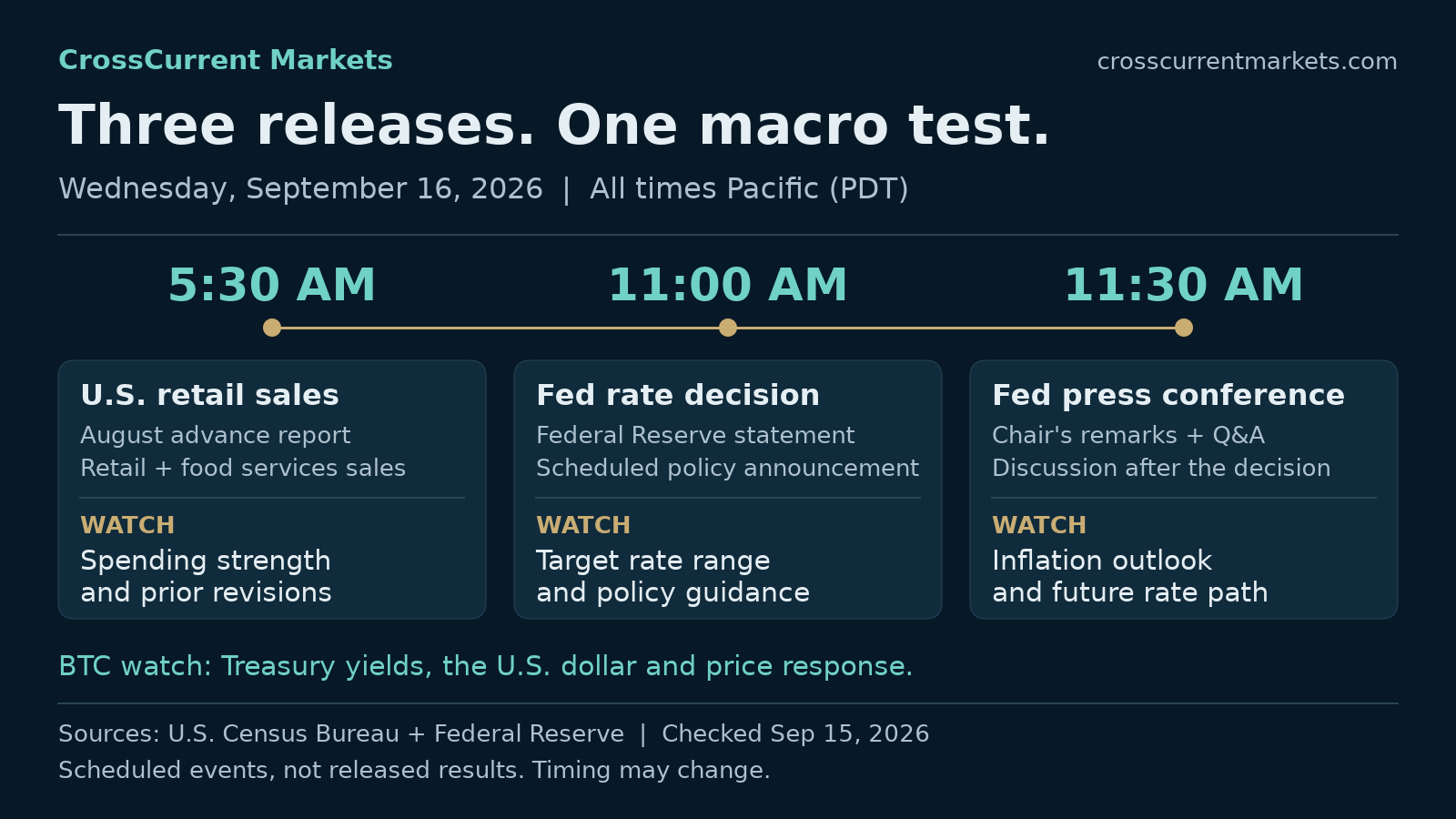
The August U.S. retail and food services sales report is scheduled for 5:30 a.m. Pacific. It measures sales at retailers and food-service businesses; it is not a report on Bitcoin trading. We will examine spending strength and revisions to earlier estimates. The Fed decision follows at 11 a.m., with the press conference at 11:30 a.m. Pacific. These are scheduled events, and no outcome is assumed. Census release schedule, Federal Reserve calendar.
Our near-term questions are whether the next complete ETF sessions sustain inflows, whether funding and dollar conditions ease, and how Bitcoin responds to the actual data and policy guidance. Sustained inflows alongside easier conditions would strengthen the demand case. Renewed outflows or rising yields and a firmer dollar would weaken it. A price move without broader confirmation would leave the assessment mixed.
Method and limits
The morning research cutoff was 7:10 a.m. Pacific on September 15. Each observation retains its own date and check time. BTC's return uses the last price and 24-hour opening price from one Coinbase response. Stablecoins use matched prior-week balances. ETF figures use complete trading sessions. Options comparisons use completed hours.
This report separates observations from CrossCurrent's interpretation. It does not present a composite liquidity score, a model forecast or personalized trading instructions. Missing information remains missing. The sources above can revise their live pages; this article preserves the reviewed morning snapshot.
Archived report · September 15, 2026. Values retain their original dates.