
Historical report · observations from September 14, 2026
 Enlarge ↗
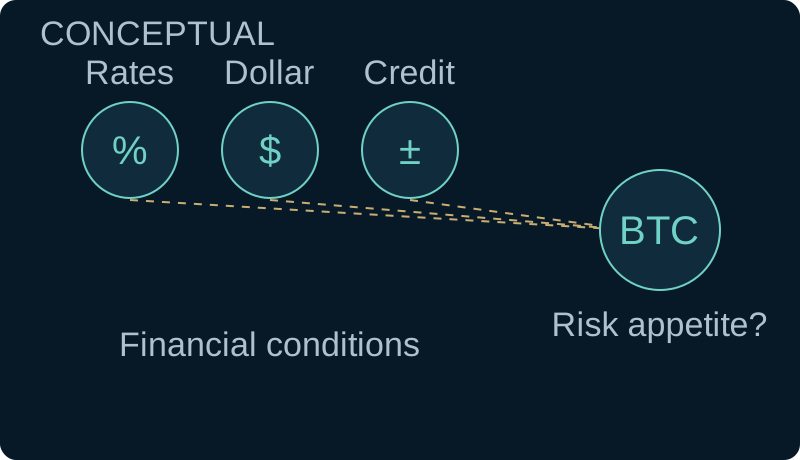
Possible channels. Direction and timing vary.
Read the full analysis and sources
An interest-rate decision can matter for Bitcoin even though Bitcoin does not pay interest. Policy affects the conditions under which people borrow, hold cash and take financial risk. The useful research question is how those conditions change, and whether crypto demand changes with them.
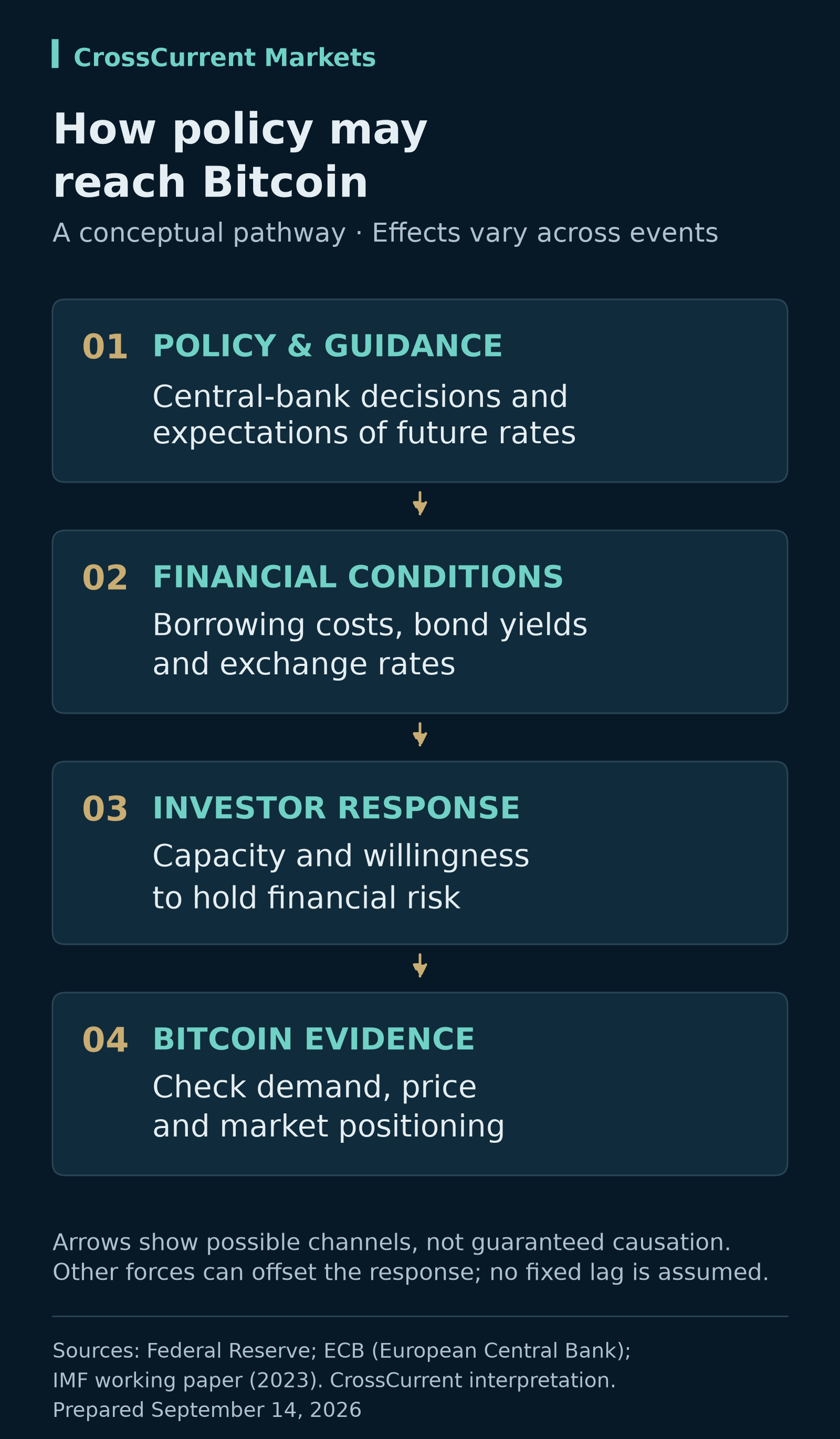
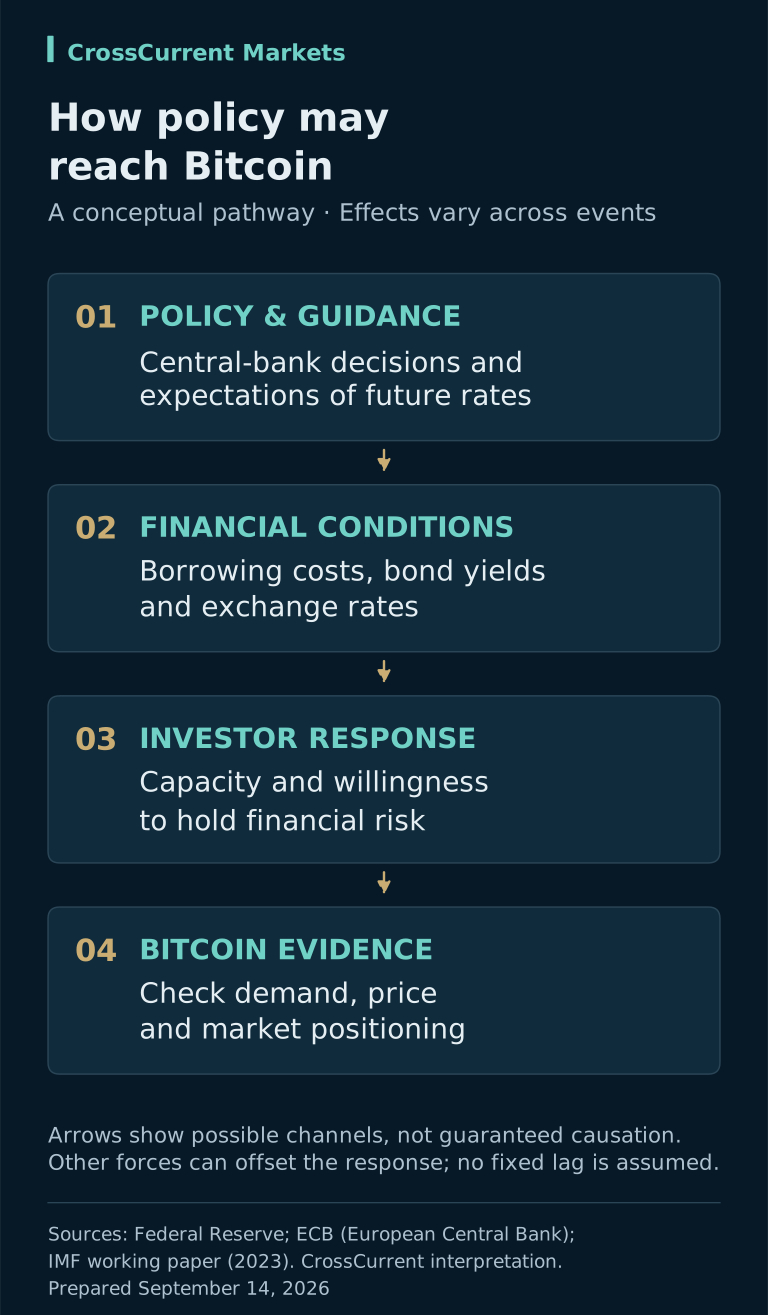
Our framework follows a sequence: identify the policy change, examine its transmission through financial markets, then test whether Bitcoin-specific evidence supports the interpretation. That sequence helps prevent a rate announcement from becoming an unsupported price prediction.
Start with the decision, its size and its effective date
On September 10, 2026, the ECB (European Central Bank) announced a 25-basis-point increase, with its deposit rate becoming 2.50% on September 16. Twenty-five basis points means 0.25 percentage points. The announcement date and the date the new rate takes effect are separate facts. ECB policy decision.
The Federal Reserve's decision was a different event: it was scheduled for September 16 at 11:00am Pacific Time, followed by the press conference at 11:30am PT. Its outcome was unknown when this article's September 14 example was prepared. Federal Reserve calendar.
These distinctions are the starting point for reliable analysis. A research note should identify which central bank acted, which rate changed, how large the change was, and when it applies. Only then can it explain a possible market consequence.
Follow the cost of funding
The Federal Reserve explains that its policy rate influences other borrowing costs, while longer-term rates also reflect expectations about future policy and economic conditions. Guidance therefore matters alongside the current decision. Federal Reserve explanation of monetary policy.
For Bitcoin research, our working hypothesis is that more expensive financing can reduce some investors' capacity or willingness to hold volatile assets. That is a channel to investigate, rather than a fixed formula for BTC returns.
We would ask whether the relevant borrowing costs actually rose, how long the change persisted, and whether the effect appeared in crypto financing or positioning. If those observations are missing, the policy announcement leaves part of the explanation unresolved.
The distinction also runs in the other direction. Easier policy could improve access to funding, but access does not specify where investors put that money. It could support many assets, debt repayment or cash holdings. A BTC-specific conclusion needs BTC-specific evidence.
Watch expectations, asset prices and the dollar
The ECB describes monetary transmission through market rates, expectations, asset prices and exchange rates. Those channels interact, and their effects can take different amounts of time to appear. ECB transmission framework.
For our analysis, this creates two separate questions. First, did the decision or guidance change the expected policy path? Second, did the subsequent market response support the proposed effect on Bitcoin?
Consider a hypothetical unchanged policy rate accompanied by guidance suggesting that borrowing costs will stay elevated longer. We would examine whether bond yields and funding conditions tightened despite the unchanged headline rate. Conversely, a headline cut would deserve closer scrutiny if credit conditions deteriorated at the same time.
The dollar belongs in that review because relative interest rates and expectations can affect exchange rates. However, an isolated euro-area rate decision does not supply enough information to forecast the dollar, much less Bitcoin. Our preferred evidence is the observed currency response alongside a clearly defined rate comparison.
This is why our daily report dates the dollar and Treasury observations explicitly. An old foreign-exchange observation cannot establish the market's reaction to a new decision.
Risk appetite is a plausible channel, with limits
A 2023 IMF working paper by Natasha X Che, Alexander Copestake, Davide Furceri and Tammaro Terracciano found evidence that U.S. monetary tightening reduced a common crypto price factor through investors' willingness to take risk. It supports examining monetary policy as part of crypto research. It does not supply a guaranteed reaction to each future announcement, and it represents the authors' research rather than an official IMF forecast. The Crypto Cycle and US Monetary Policy.
Our practical use of that research is to look for competing explanations. If Bitcoin rises while policy conditions tighten, we should investigate demand, positioning and market access rather than declare the price move impossible. If Bitcoin falls during an easing period, we should ask what other pressures may be stronger.
The useful discipline is to make the proposed link testable: state the channel, the observation period and the evidence that would weaken it. A story that treats every outcome as confirmation has little research value.
A policy rate and SOFR answer different questions
SOFR is an observed benchmark for borrowing cash overnight against U.S. Treasury collateral. It is a funding-market measure rather than the Fed's policy target. In the September 14 research record, SOFR's September 11 value was 3.62%, compared with 3.65% on September 4: a decline of 3 basis points. New York Fed SOFR methodology, dated rate observations.
That example demonstrates why the measurements should stay distinct. We could describe a modest decline in the cost captured by SOFR. We could not use that decline to claim that the Fed had announced a policy cut, or that every crypto participant's financing had become cheaper.
Our reading becomes stronger when repeated observations and other funding measures tell a consistent story. A single benchmark is still useful, provided the conclusion stays within its scope.
How we will assess a policy event
| Research question | Evidence to examine | What would remain uncertain |
|---|---|---|
| What changed? | The official decision, effective date, projections and guidance. | Whether the change differed from expectations, unless an expectations source was recorded beforehand. |
| Did funding conditions respond? | Comparable observations for short-term rates, Treasury yields and credit conditions. | Whether the initial response will persist. |
| Did currencies reinforce the story? | A dated dollar or exchange-rate series with a specified comparison window. | Which factor drove the currency move. |
| Did Bitcoin demand confirm it? | Complete ETF flows, comparable stablecoin supply and relevant market-structure evidence. | How much of BTC's move any one channel explains. |
These are research questions, not a mechanical score or trading rule. Conflicting observations should remain visible in the written assessment. A useful update can say that funding improved while demand confirmation remains limited; it does not need to force every measure into one label.
Our rates, dollar and credit guide defines the broader coverage. The global liquidity guide explains why policy rates, money aggregates and credit measures should be identified separately. Together they provide the framework for revisiting a policy interpretation as new evidence arrives.
Educational research. The September 2026 example is dated context, not a forecast of the pending decision or personalized investment advice.
Archived report · September 14, 2026. Values retain their original dates.