
Historical report · observations from September 19, 2026
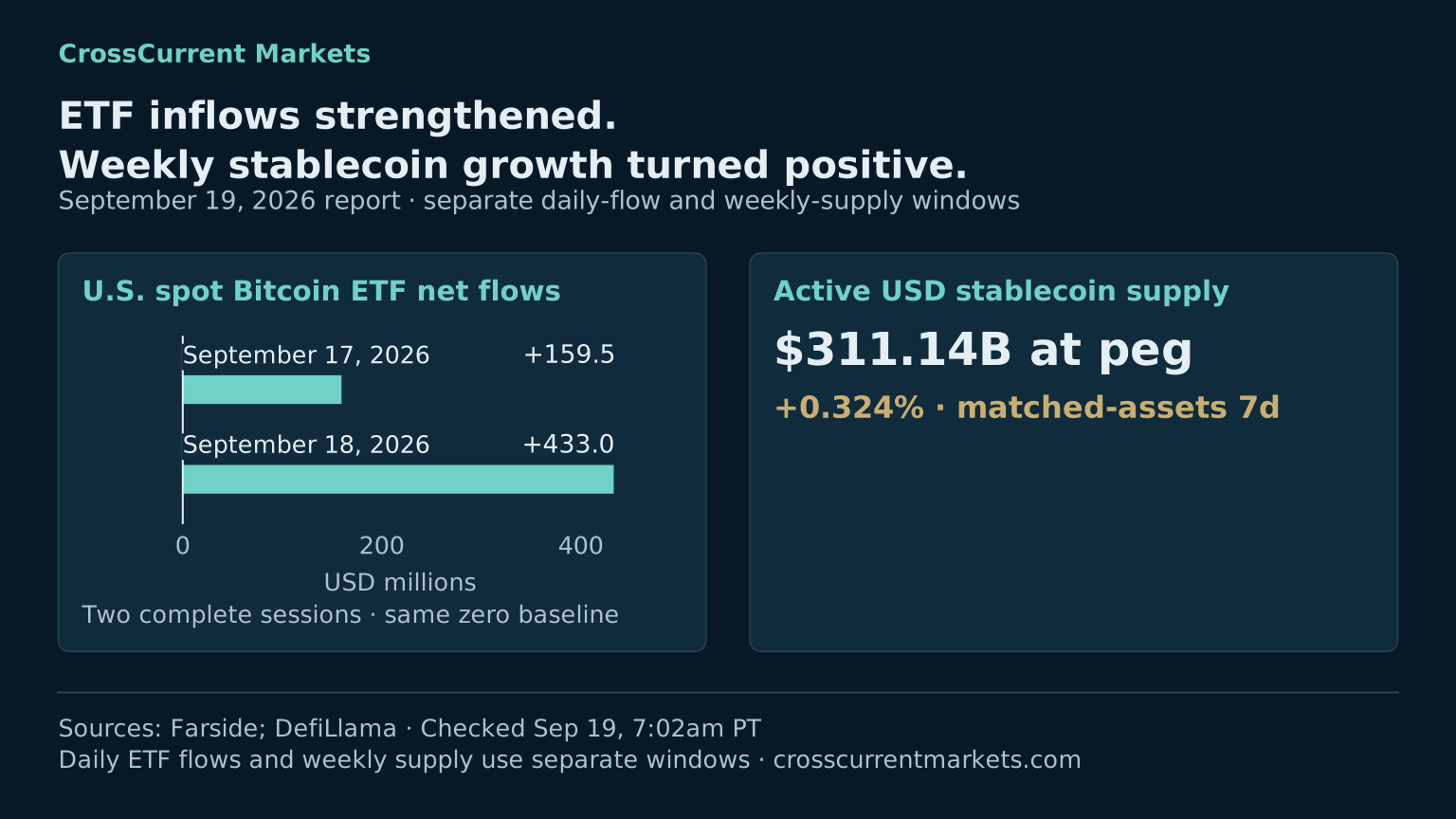
More funds buying Five funds had inflows Friday; one still dominated.
Nearly flat week Friday’s $433M inflow leaves the week at +$6.1M.
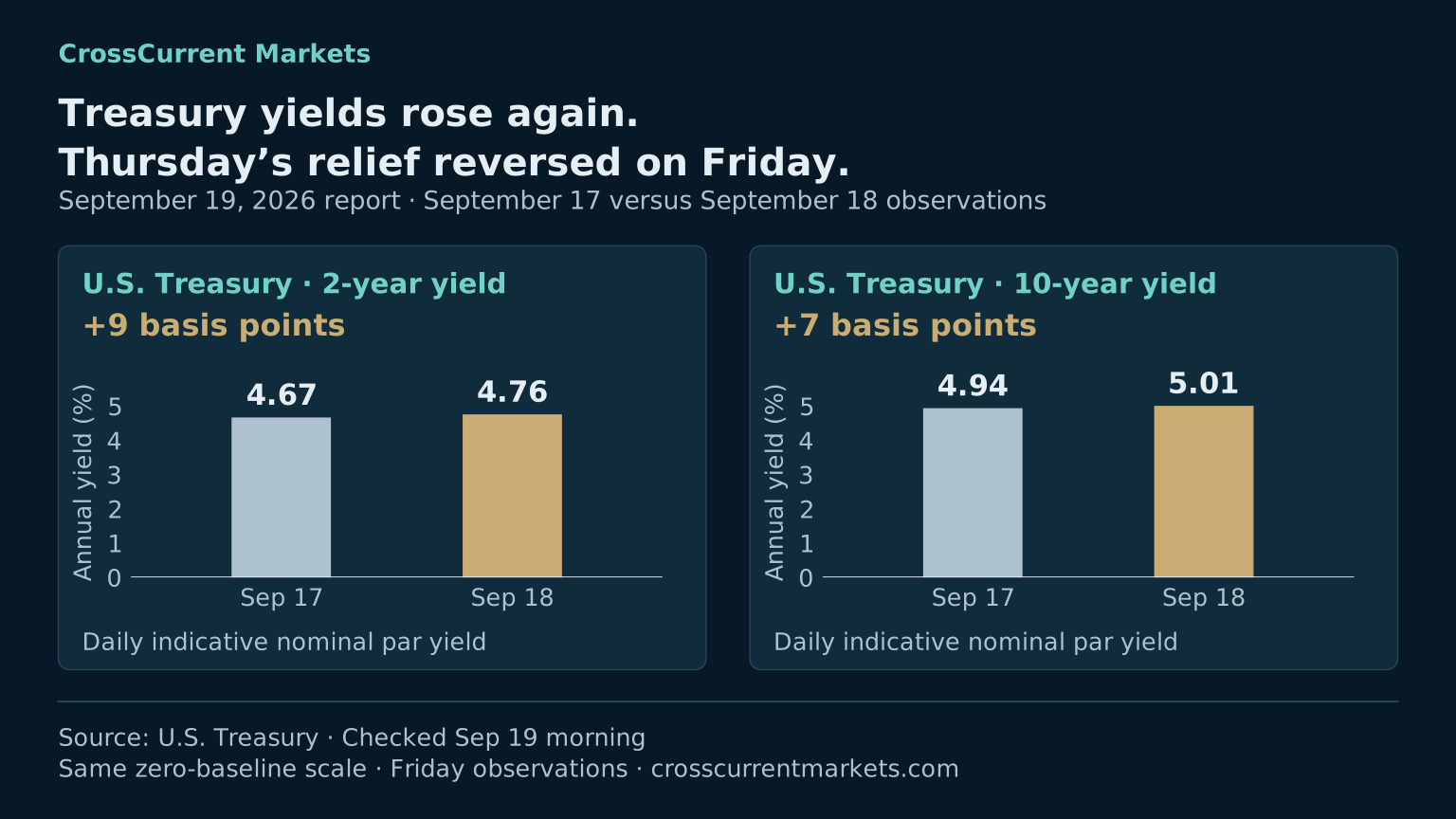
Mixed backdrop Stablecoin supply grew while Treasury yields rose.
Read the full analysis and sources
Friday brought a stronger Bitcoin ETF session: $433.0 million in net inflows, with five funds receiving inflows instead of one the previous day. Weekly stablecoin supply growth also turned positive in our morning check. Those are improvements in the demand backdrop. They are not yet evidence of a sustained recovery: the full ETF week netted only $6.1 million, and Treasury yields rose again.
Morning snapshot: Coinbase BTC/USD was $81,308.30, up 0.49% over its rolling 24-hour window, checked September 19 at 7:02am Pacific. This report preserves that observation; it is not a live quote. Saturday crypto readings and Friday fund-market observations cover different periods.
Three takeaways
- Demand improved: Friday's ETF inflows were larger and spread across more funds, although one fund still dominated the net total.
- The week was nearly flat: the last two positive sessions largely repaired earlier outflows.
- Macro confirmation was mixed: Treasury yields rose even as crypto-specific demand measures improved.
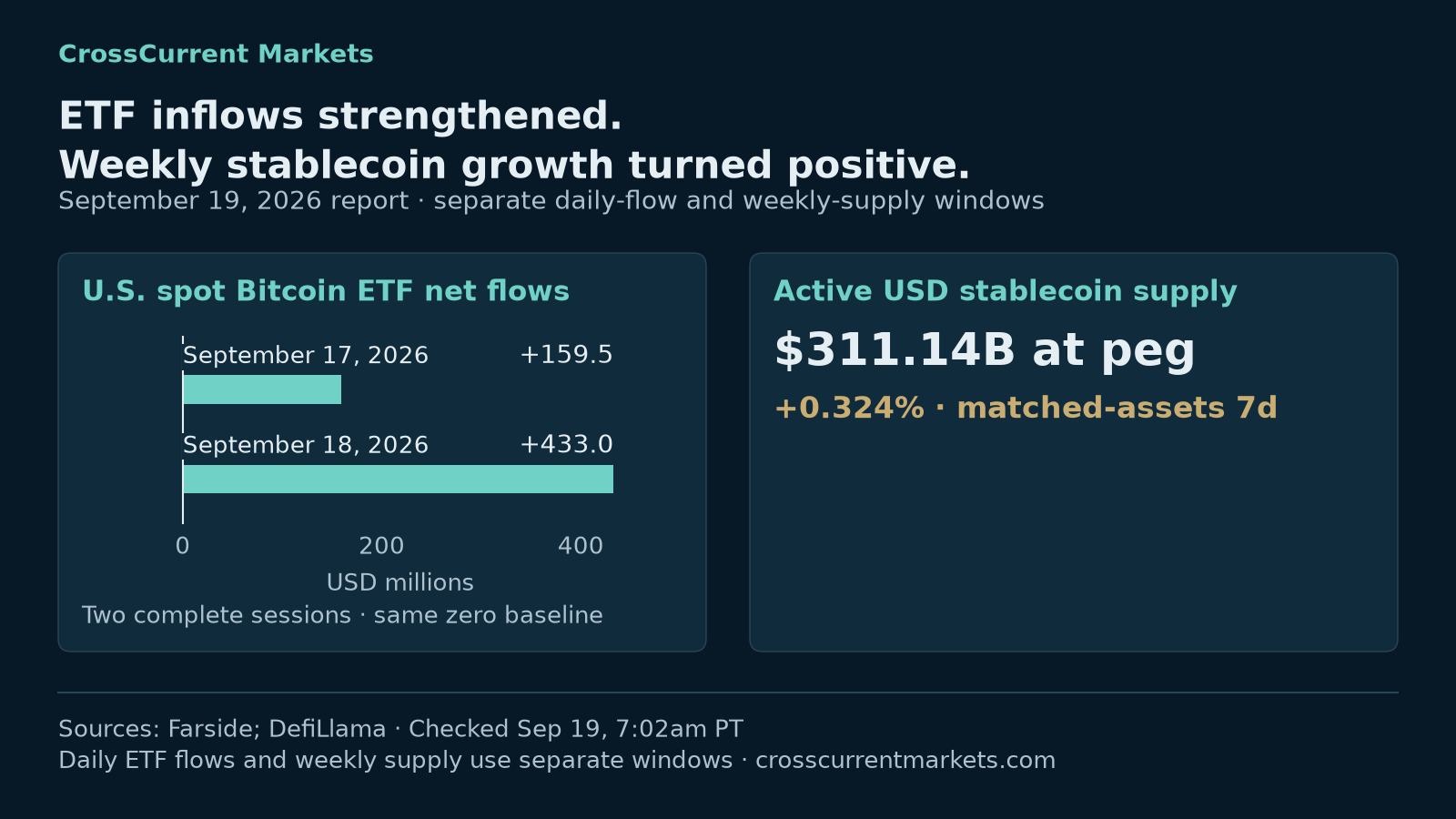
More funds participated, but buying remained concentrated
Farside's U.S. spot Bitcoin ETF table recorded $433.0 million in net inflows on September 18, compared with $159.5 million on September 17. Friday's positive entries were FBTC at $310.7 million, IBIT at $108.4 million, BITB at $9.7 million, HODL at $2.3 million and ARKB at $1.9 million.
Five funds receiving inflows is broader participation than Thursday's single positive fund. But FBTC alone supplied approximately 72% of the net inflow. We should distinguish broader participation from evenly distributed buying.
ETF flows describe one investment channel. They do not identify every investor, measure all institutional activity or prove that fund demand caused a particular Bitcoin price move. Compiler figures can also be revised.
Put the strong finish beside the whole week
| U.S. trading session | Net spot BTC ETF flow |
|---|---|
| September 14 | +$159.9 million |
| September 15 | -$450.4 million |
| September 16 | -$295.9 million |
| September 17 | +$159.5 million |
| September 18 | +$433.0 million |
| Five-session total | +$6.1 million |
Thursday and Friday brought in $592.5 million after Tuesday and Wednesday lost $746.3 million. Monday's positive session lifts the complete week just above zero. The improvement is real within this series, but focusing only on Friday would overstate the week's overall strength.
This partly addresses the question in our September 18 report: would positive fund flows broaden and persist? Friday provides another positive session and more participating funds. It is too early to describe that as a durable trend, and it does not resolve the initial cause of the preceding rally.
Stablecoin supply growth turns positive
DefiLlama data showed approximately $311.14 billion in active USD stablecoin supply at peg. The matched-assets seven-day comparison rose 0.324%, versus the small weekly contraction in the previous morning's check.
Matching assets makes the comparison more consistent, but these are moving seven-day windows. The change between two reported growth rates is not a measurement of one day's issuance. Token membership, provider observations and the earlier comparison date can also change.
Stablecoin balances represent potential liquidity, not a record of money spent buying Bitcoin. Tokens can be held, transferred or used for other purposes. The positive weekly reading improves this particular supply measure; it does not by itself establish BTC demand.
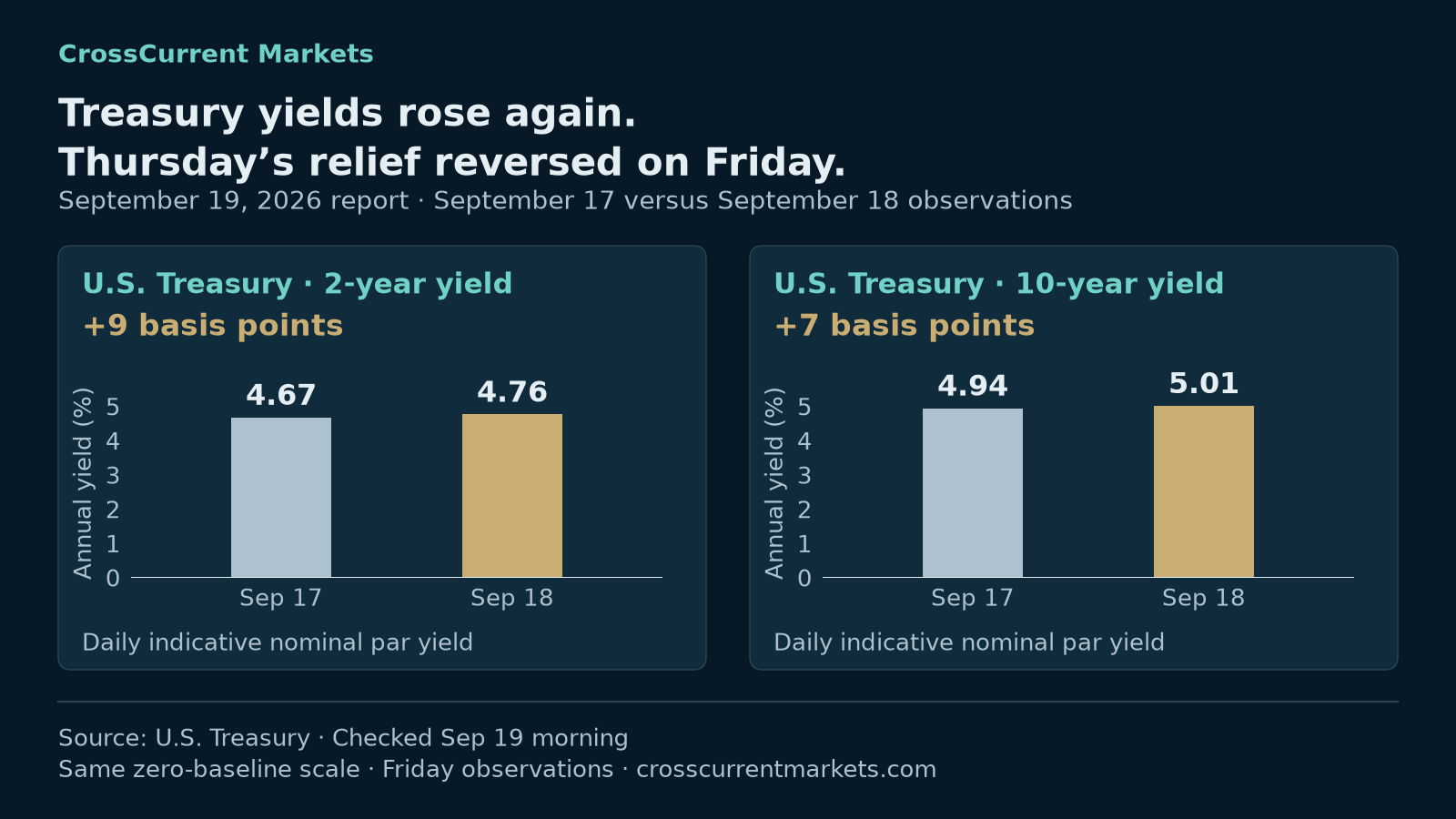
Treasury yields moved against Thursday's relief
The U.S. Treasury's daily nominal par-yield table shows the two-year yield rising from 4.67% on September 17 to 4.76% on September 18. That is an increase of nine basis points. The ten-year rose from 4.94% to 5.01%, up seven basis points.
Higher yields can make interest-bearing alternatives more attractive and tighten financing conditions, potentially weighing on risk assets. They do not mechanically dictate Bitcoin's next move. Here, their importance is that Thursday's yield relief did not continue alongside Friday's stronger ETF inflows.
These are dated Friday observations, not live Saturday rates. One basis point is 0.01 percentage point.
Lower expected volatility does not identify a direction
Deribit's Bitcoin volatility index closed at 34.92 for the September 19 hour ending 7am Pacific, compared with 35.29 at the corresponding close a day earlier. The decline was 0.37 index point.
DVOL reflects 30-day implied volatility derived from options. A lower reading does not tell us whether price will rise or fall. It also cannot establish that Friday's rally was driven by short liquidations. See our volatility-versus-demand explainer for that distinction.
What to watch after the weekend
Crypto trading continues through Saturday and Sunday. Under the NYSE regular-session calendar, U.S. ETFs next trade Monday, September 21. There is no regular Saturday ETF session to report as a zero-flow day. Monday's full fund totals will require their own reporting cycle.
Our next questions are whether ETF inflows remain positive across more funds, whether weekly stablecoin supply continues expanding, and whether yields ease. The Federal Reserve's H.10 release is scheduled for September 21 at 1:15pm Pacific; its publication time and the underlying observation dates are different things.
Our assessment is improved crypto-specific demand evidence alongside a less supportive yield backdrop. This is independent public-source analysis, not a model-generated trading signal or a recommendation to buy or sell.
Observation notes
The opening price and return use the same archived Coinbase statistics response. All graphics retain their source dates and morning check times. Daily ETF flows, seven-day supply growth, a rolling price return and an hourly volatility close are different measures; they should not be added together. Linked provider pages may update after this report is published.
Archived report · September 19, 2026. Values retain their original dates.