
Historical report · observations from September 16, 2026
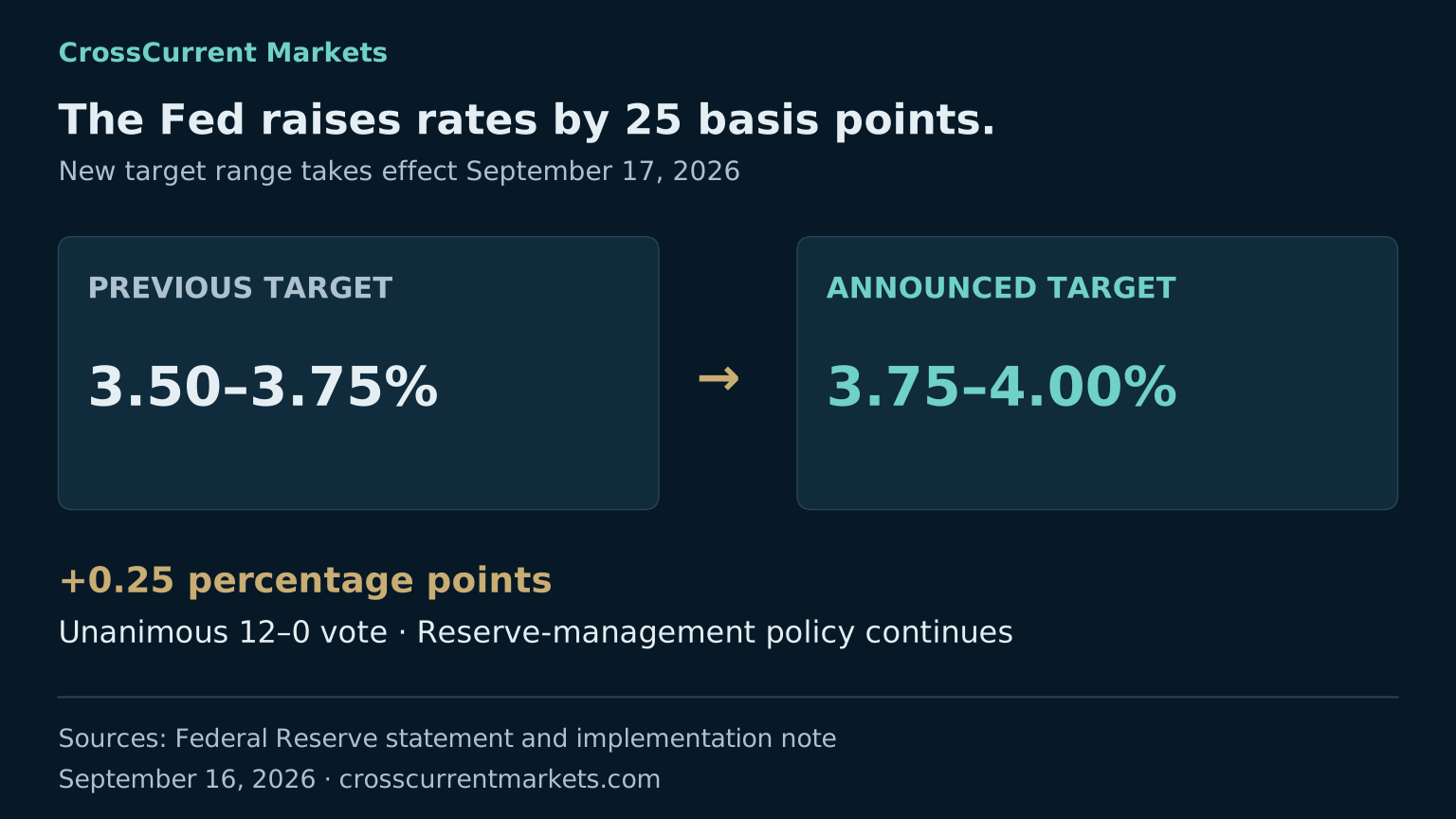
What changed The Fed raised rates; two ETF outflow sessions total $746.3M.
Why BTC Price held up despite weak measured demand. Lower implied volatility adds contrary evidence.
What to watch Fresh funding and dollar data, sustained ETF inflows and matched stablecoin supply.
Read the full analysis and sources
Bitcoin was $76,284.01, up 0.64% over the preceding 24 hours, in our September 16 check at 9:08pm PT. That resilience sits alongside tighter U.S. policy and another reported ETF outflow. Our interpretation: price is holding up better than the measured fund-demand and stablecoin-supply backdrop. That is a divergence to investigate, not proof that the policy change has no effect. Coinbase snapshot source
What changed after this morning's report
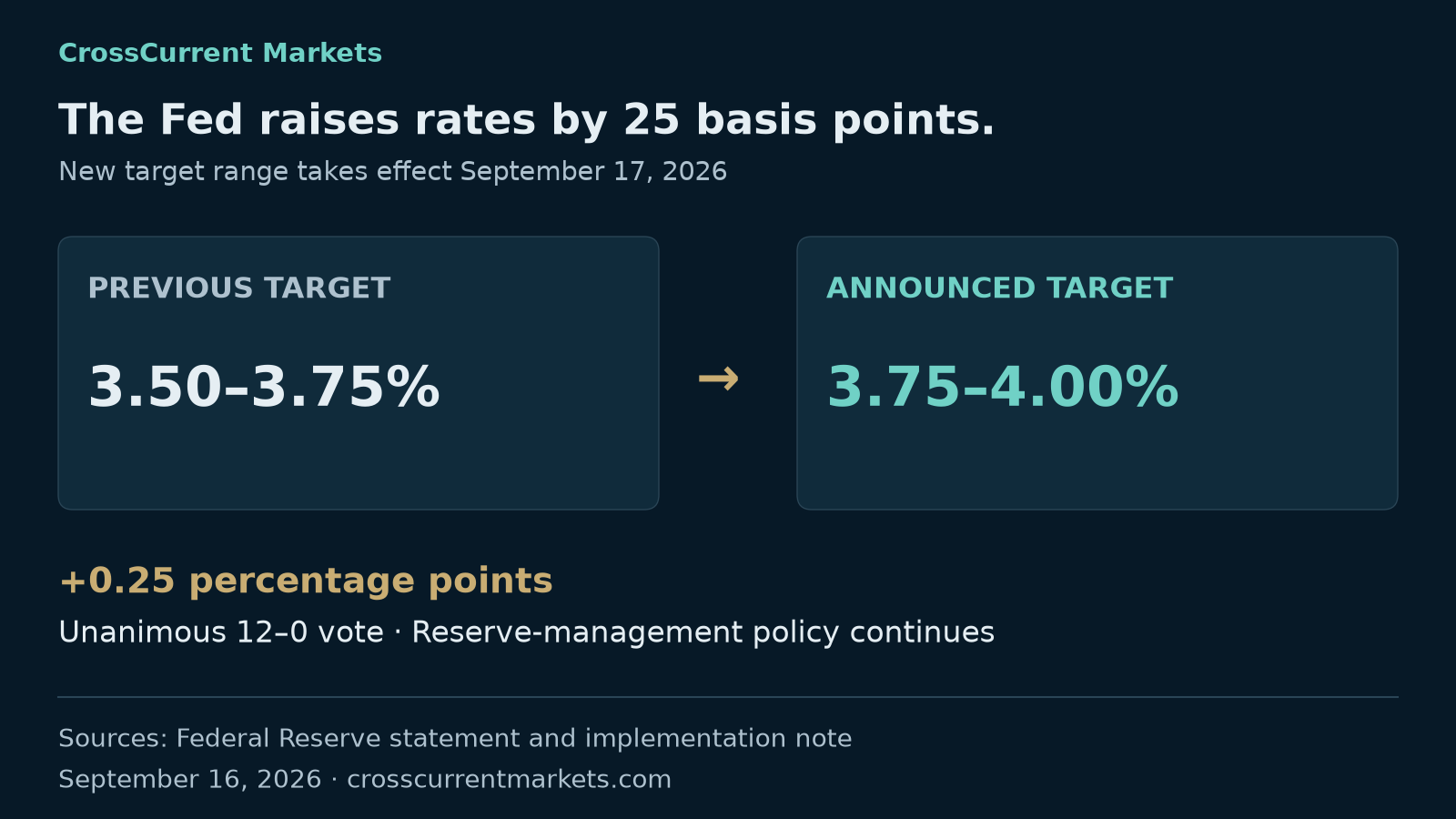
- The Fed announced a 25-basis-point increase, taking its target range from 3.50–3.75% to 3.75–4.00%, effective September 17. The vote was unanimous, 12–0. Decision
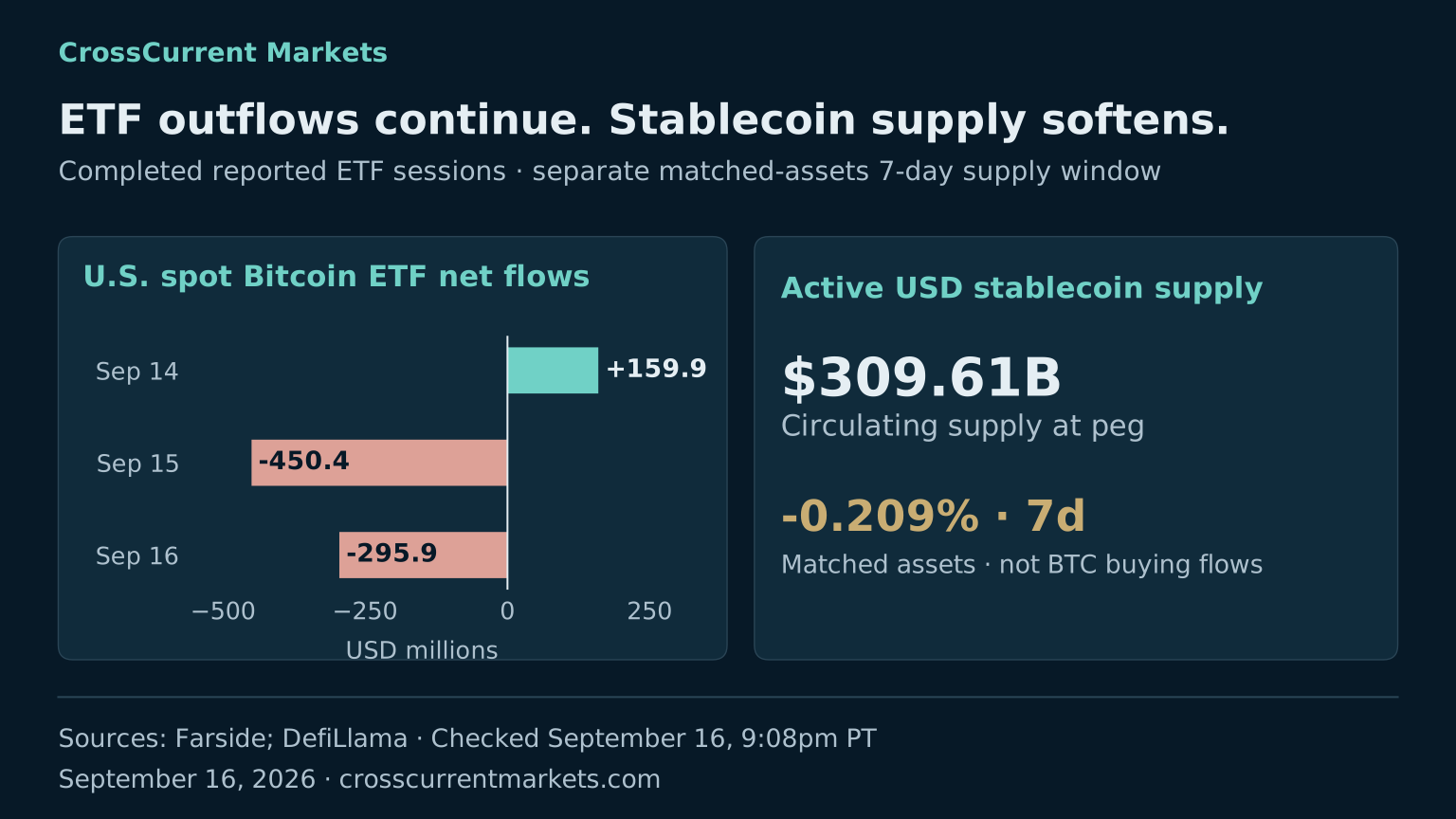
- Wednesday's U.S. spot Bitcoin ETF data are now populated: a $295.9M net outflow, following Tuesday's $450.4M. Farside
- Active USD stablecoin supply was $309.61B at peg; the matched-assets seven-day change remained negative at 0.209%. DefiLlama
- BTC's rolling daily change was positive and its options-implied volatility was lower than the corresponding hour a day earlier. These are counterpoints to a uniformly negative market reading, not evidence of renewed ETF demand.
The decision and the projected path
The new target range is an announced policy setting. It should not be confused with an already observed overnight market rate. The Fed's implementation note makes September 17 the effective date and sets interest on reserve balances at 3.90%. Implementation note
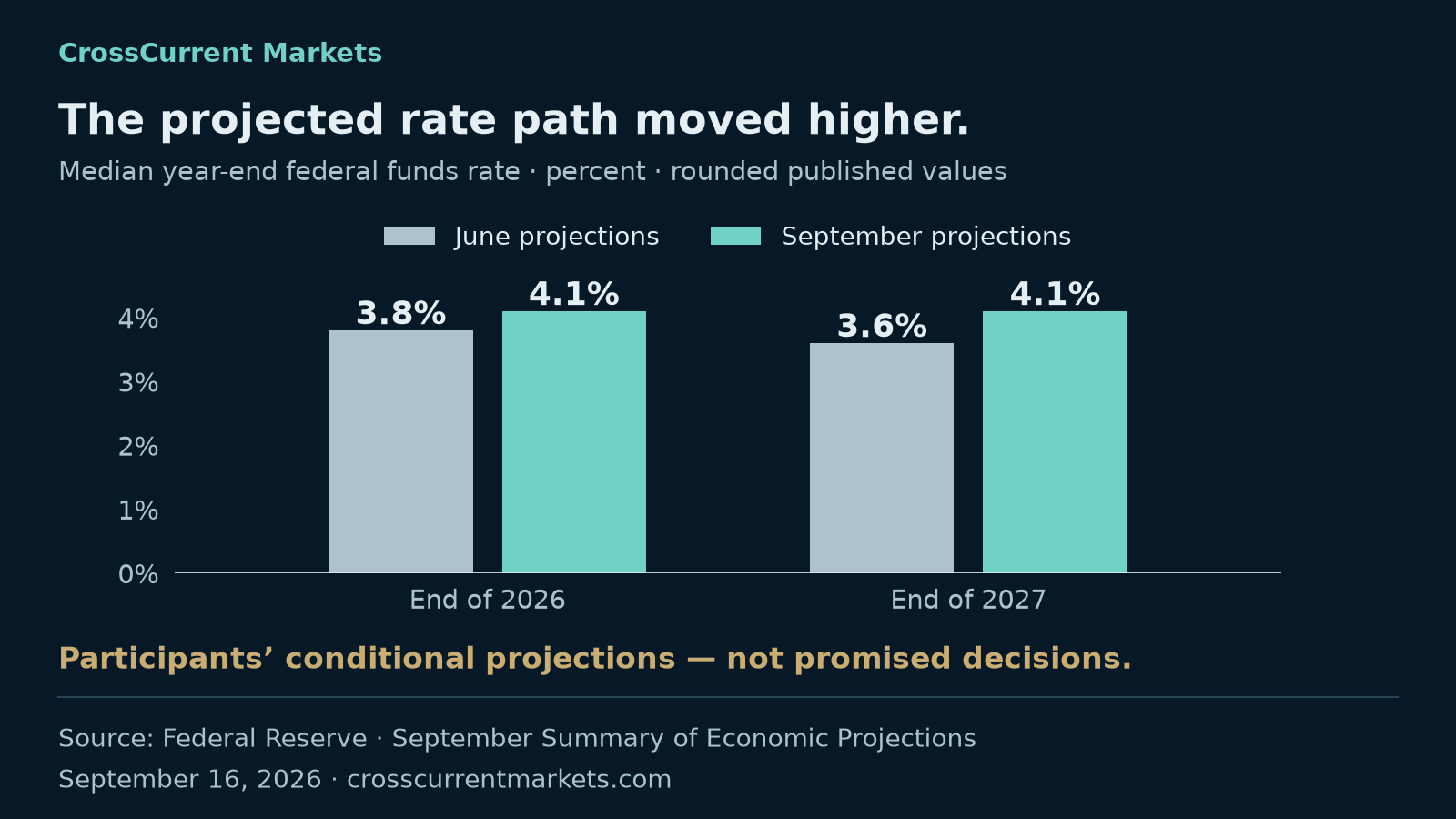
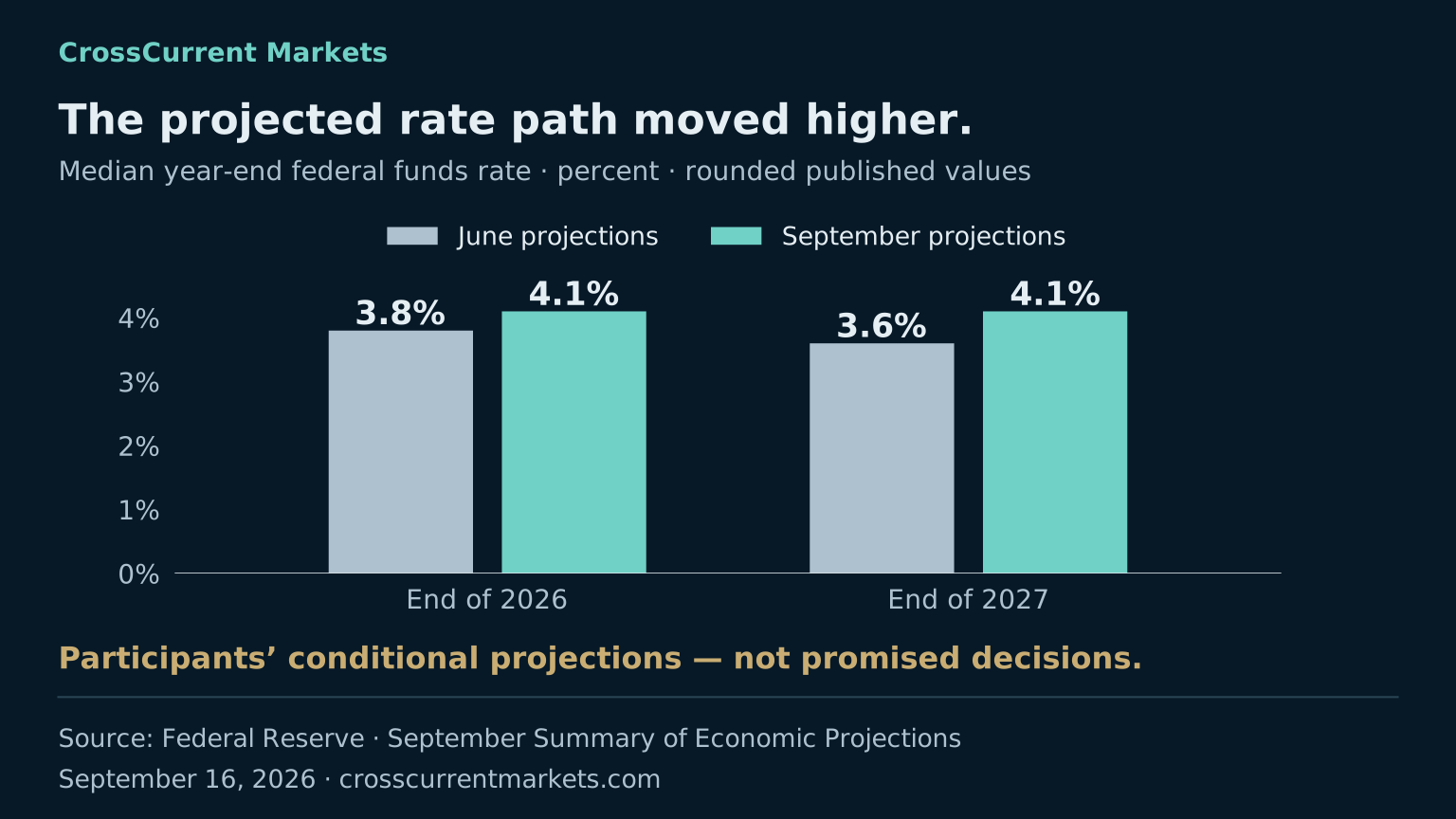
September's published median year-end rate projection is 4.1% for both 2026 and 2027, compared with June's 3.8% and 3.6%. These rounded medians summarize participants' judgments; they are neither committed decisions nor market probabilities. The current target range and a year-end projected midpoint answer different questions. Projection tables and definitions
In his published opening remarks, Chair Kevin Warsh emphasized persistent inflation, economic resilience and financial conditions he did not regard as broadly restrictive. This recap uses the Fed's preliminary opening-statement transcript; it does not claim a verified full question-and-answer transcript. Official opening remarks, pages 1–3
Our read: the case for an imminent broad easing impulse is weaker after this decision. For Bitcoin, the transmission still depends on financing costs, the dollar, positioning and actual demand. A higher policy rate is one input, not a mechanical price forecast.
Fund demand remains soft
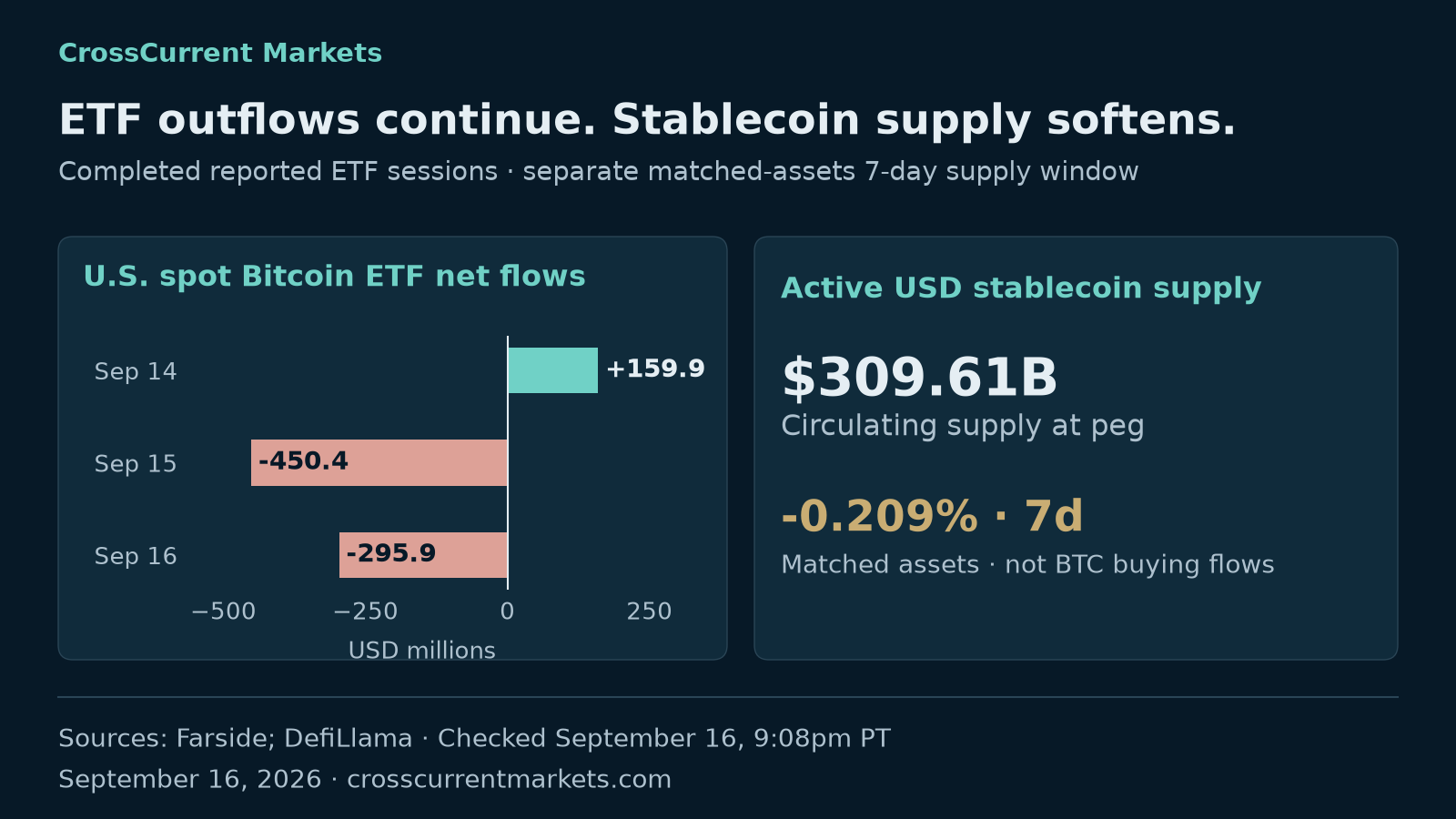
All twelve fund entries were populated for September 16 in the retrieved Farside table. Tuesday and Wednesday sum to $746.3M of net outflows. Including Monday's $159.9M inflow leaves the three sessions at $586.4M net outflow. The smaller Wednesday loss is an improvement in magnitude, but it is still an outflow. These reported figures can be revised. Farside ETF table
Daily ETF totals cover an entire session. They do not isolate orders placed after the Fed decision or identify why investors acted. They also describe only one Bitcoin investment channel. We therefore cannot attribute the full Wednesday outflow to the announcement or infer total market selling from it.
The stablecoin reading uses active USD-pegged assets and compares the same asset IDs with available history. It measures outstanding supply at peg, not dollars actually deployed into BTC. Changing provider coverage and rolling comparison windows also mean the difference between morning and evening totals is not a clean measure of intraday issuance. DefiLlama data
Counterevidence: price and volatility
Deribit's BTC DVOL closed at 35.77 for the hour ending at 9pm PT, versus 38.51 for the corresponding hour on September 15: down 2.74 index points. The still-forming next hour was excluded. DVOL describes 30-day annualized implied volatility, not the expected direction of BTC. Deribit data
A positive 24-hour return and lower implied volatility argue against describing this snapshot as a market-wide panic. They do not resolve the weak flow evidence. The price window includes trading both before and after the Fed announcement, so it is not a measured announcement-to-check return.
Other lenses and their timing limits
| Lens | Latest checked observation | What it can tell us |
|---|---|---|
| Funding | September 15 SOFR 3.64%; effective fed funds 3.63% | These observations precede the new rate's effective date. |
| Reverse repo | September 16 accepted amount $5.375B, versus $0.700B the previous day | This operation closed before the Fed announcement; it is not a post-decision liquidity response. |
| Treasuries | Retrieved H.15 table ended September 15: two-year 4.67%, ten-year 5.00% | Useful prior-day context, insufficient to measure Wednesday's yield reaction. |
| Financial conditions | Chicago Fed NFCI −0.560 for the week ending September 11 | Below-zero means looser-than-average conditions; the weekly observation predates this meeting. |
| Rotation | CoinLore BTC market-cap share 59.00% at the evening check | Provider-universe market-cap share is not a direct capital-flow measure. |
Sources: New York Fed rates, reverse-repo operations, Fed H.15, NFCI, CoinLore.
Regional conditions are not uniform. The ECB (European Central Bank) increase announced September 10 took effect September 16. China’s August releases remain mixed, with industrial growth alongside weak consumption growth. The Bank of Japan’s September 17–18 meeting, in Japan's local calendar, is the next regional policy event we are watching. These are separate economies and release windows, not components of an invented daily global-liquidity score. ECB decision, China NBS release, BOJ calendar
What would change the assessment
Sustained ETF inflows together with expanding matched stablecoin supply would strengthen the demand case. Persistently higher financing costs and further outflows would strengthen the headwind case. Fresh, comparable Treasury and dollar observations are needed before we describe those markets' post-Fed response. The retrieved official dollar series ends September 11. Fed H.10
Our horizon is the coming sessions, not a specific price target. We will distinguish new observations from revisions and preserve this dated assessment. This is independently sourced informational analysis; no approved quantitative model export or model forecast was available for this run.
For the policy mechanics, read Why a Fed rate hike and reserve management can coexist.
Archived report · September 16, 2026. Values retain their original dates.