
Historical report · observations from September 16, 2026
Two separate tools Policy rates set borrowing conditions; reserve operations support implementation.
Read the dates The new 3.75–4.00% target takes effect September 17.
Test the transmission Check actual financing conditions and crypto demand before attributing a BTC move.
Read the full analysis and sources
The September Fed decision presents two facts together: a higher policy-rate range and continued management of bank reserves. For Bitcoin research, combining both into a single label such as “liquidity up” or “liquidity down” loses the distinction that matters. We need to track the price of short-term money, the supply and distribution of reserves, and the behavior of investors separately.
Start with the action and its effective date
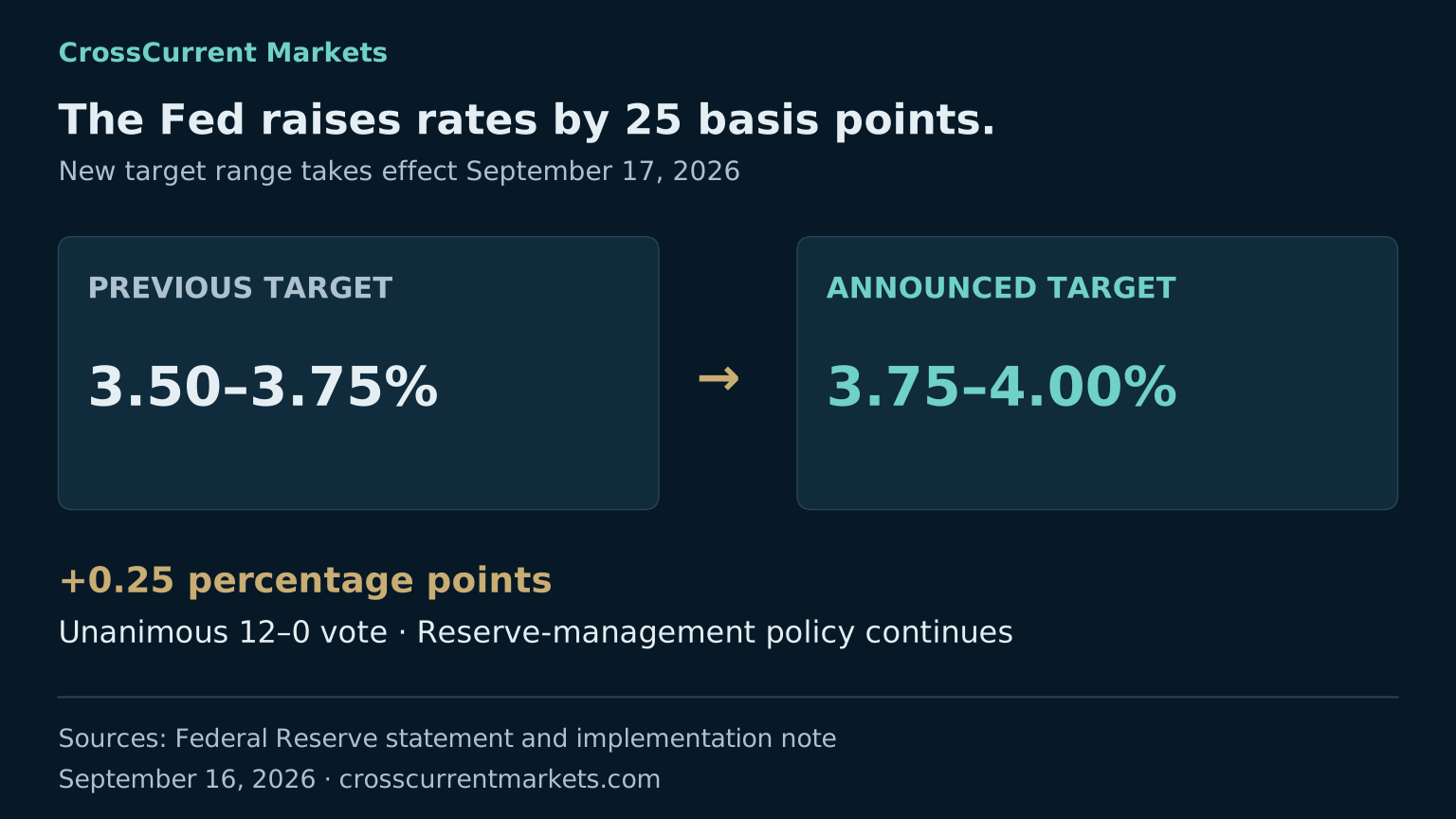
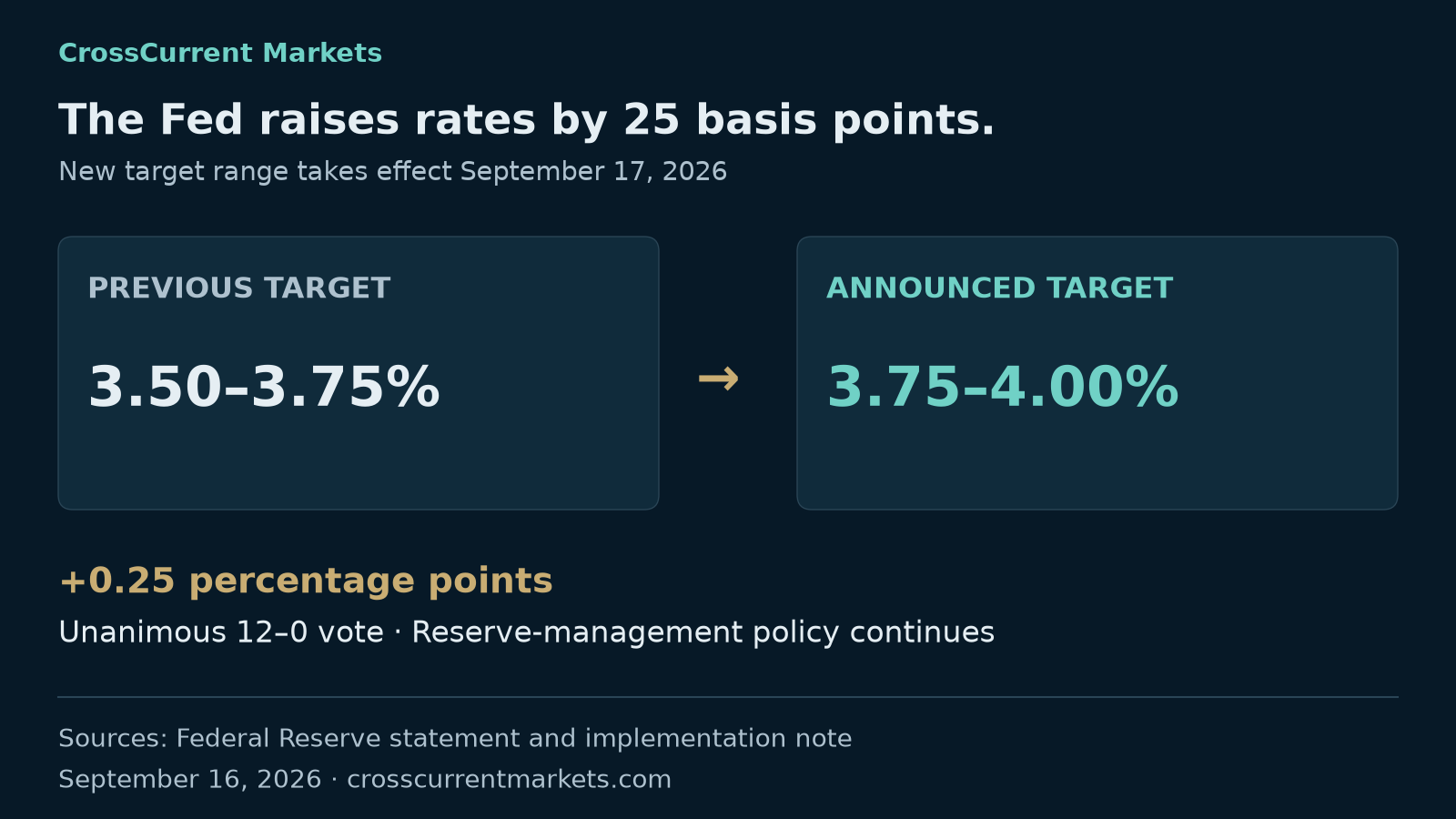
The Fed announced a quarter-percentage-point increase on September 16. The new target range is 3.75–4.00%, effective September 17. A 25-basis-point change means 0.25 percentage points; it is not a 25% increase in the rate. Fed decision, implementation details
This distinction matters on a dashboard. An announced target and a measured funding rate have different dates and definitions. A September 15 funding observation can remain numerically correct while being unsuitable as evidence of how markets function under the September 17 setting. A report should display both dates instead of silently relabeling an old observation.
The policy rate sets a price
The Fed influences financial conditions through short-term interest rates and expectations about future policy. Those conditions can affect borrowing, spending and investment. Bitcoin's response may involve financing costs, relative asset attractiveness, the dollar and risk appetite, but the strength and timing of those channels are uncertain. Federal Reserve explanation of monetary-policy transmission
Our research implication is to test the links in that chain. A rate decision alone does not tell us how much leverage was reduced, whether buyers entered the spot market, or which assets received new capital. Those are additional observations to collect. We should not turn a plausible mechanism into a claim that a specific BTC move was caused by the decision.
Reserve management addresses implementation
The September implementation note permits purchases of Treasury bills and, if needed, short-dated Treasuries to maintain ample reserves. It also instructs the Desk to roll over Treasury principal and reinvest agency principal into bills. At the same time, it raises administered rates, including interest on reserve balances to 3.90%. Implementation note
Our interpretation: balance-sheet operations need to be classified by their stated purpose and actual execution. An instruction to preserve ample reserves is not, on its own, evidence of a broad easing program or a quantified injection into crypto. The note does not provide a direct BTC-demand measurement. We would need subsequent balance-sheet and market data to quantify what occurred.
This is why we retain separate dashboard tiles and observation dates. A policy-rate increase, a change in reverse-repo usage and a shift in stablecoin supply should not be added into one dollar total. Their units, institutional settings and economic meanings differ.
Read projections as conditional judgments
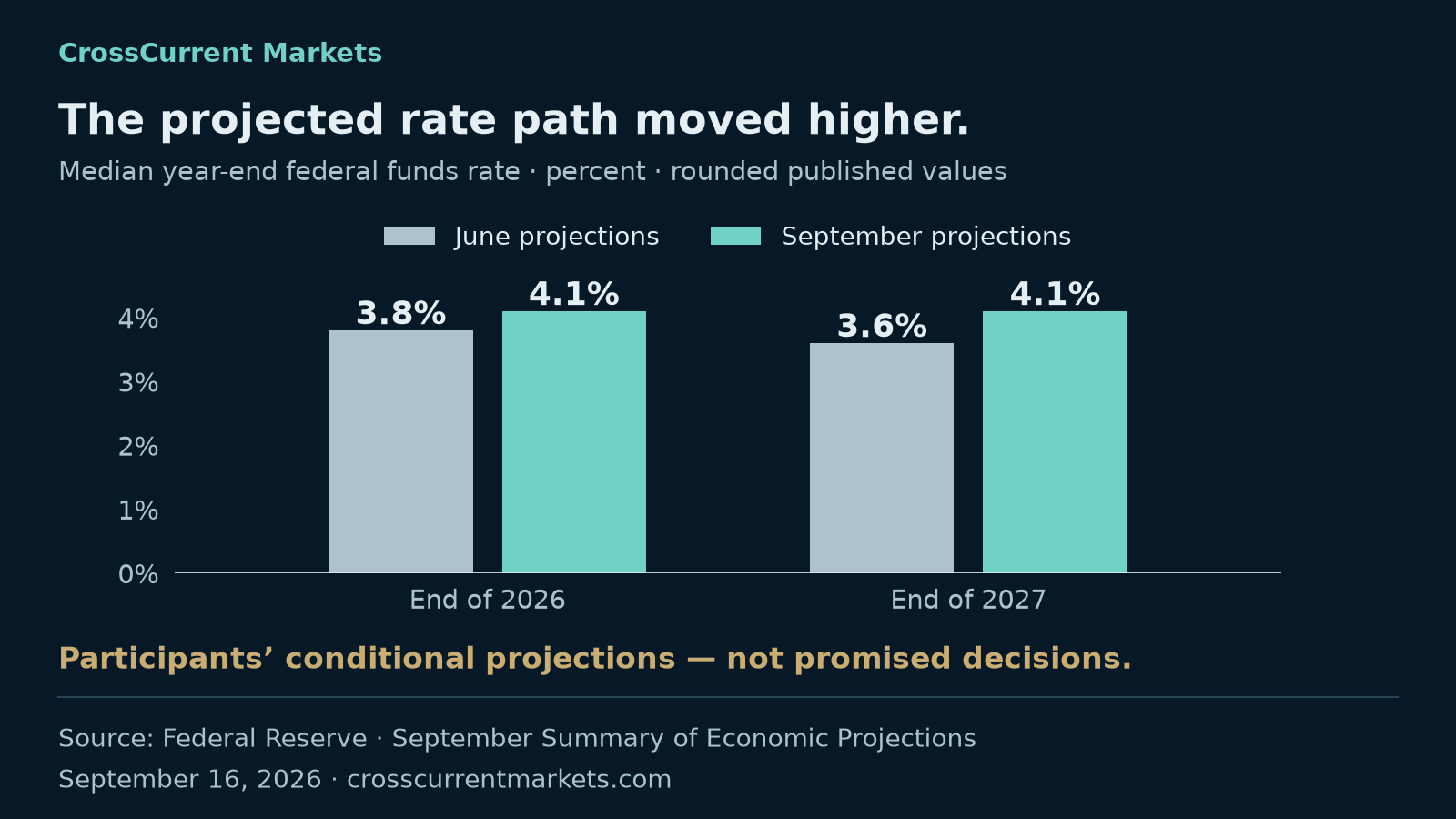
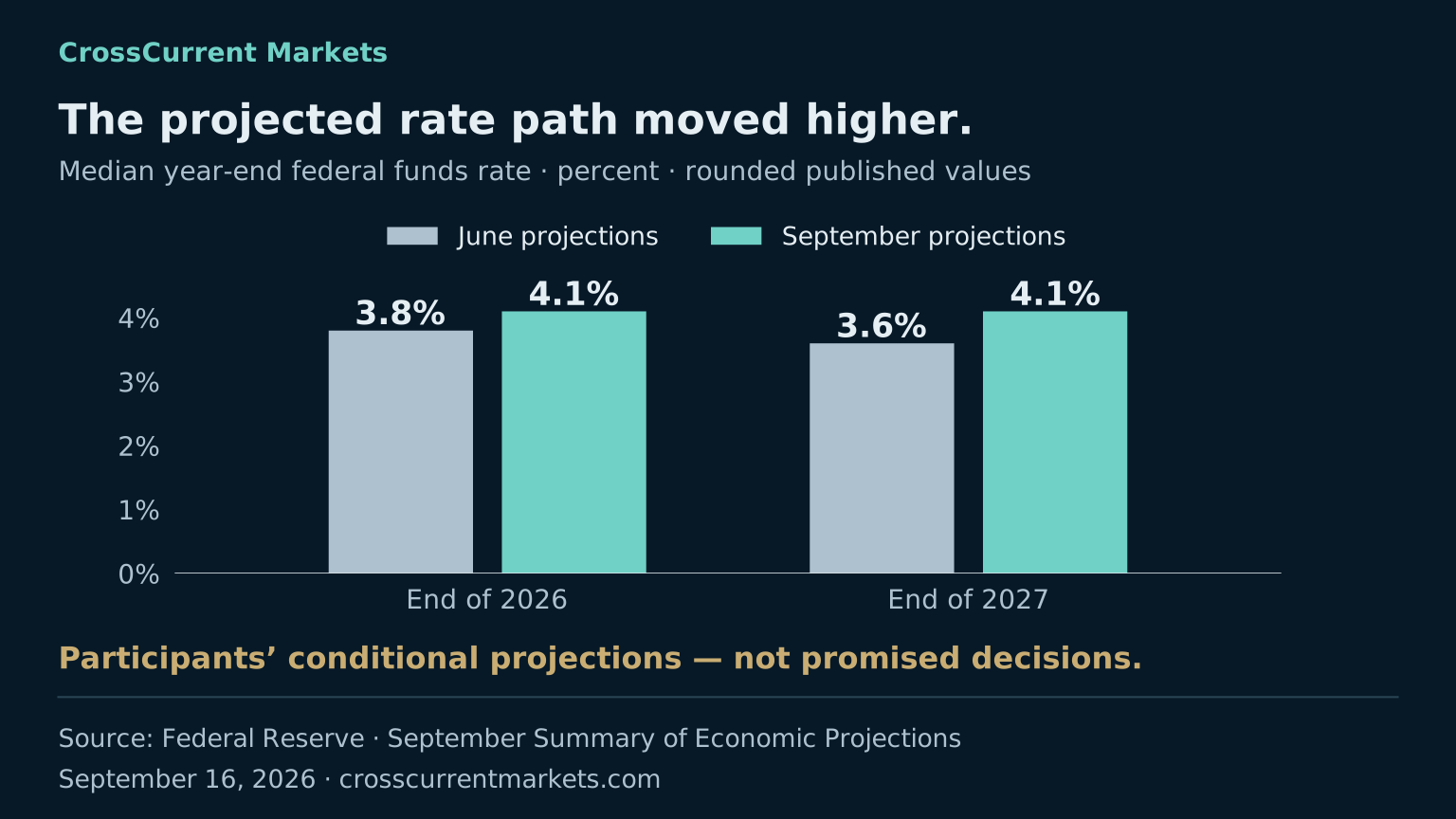
The September projection table puts the median year-end rate at 4.1% in both 2026 and 2027. The figures refer to projected target midpoints and are rounded in the summary table. They do not mean the Fed set a 4.1% target today. Projection definitions
The 2026 dots show two participants at 3.875%, twelve at 4.125% and four at 4.375%. That distribution puts most participants above the midpoint of the newly announced range by year-end. It remains conditional on how the economy evolves; it is not an announced timetable or a probability distribution drawn from market prices. September dot distribution
The practical question for our research is what would make that assessment change. Inflation, employment and financing conditions belong in the follow-up work. An unqualified claim that another increase is guaranteed would go beyond the evidence.
Read the explanation without overstating the record
Chair Warsh's official preliminary opening statement gives inflation a central role and describes an economy with resilient spending and strong investment. He says the standard for sufficiently clear and timely inflation progress had not been met. We use that published text as evidence of his stated rationale. Opening statement, pages 1–3
The available document is specifically an opening statement. We have not treated it as a complete transcript of questions and answers or filled gaps with unattributed quotations. Readers should be able to distinguish the official text we checked from our own interpretation.
A useful Bitcoin follow-up framework
| Question | Evidence to inspect | Common mistake to avoid |
|---|---|---|
| What policy actually changed? | Official target range, implementation date and operational instructions | Confusing a projection with an enacted rate. |
| Did financing conditions change? | Comparable, freshly dated yields, dollar and funding observations | Using a prior-day series as a live event reaction. |
| Did crypto demand strengthen? | Completed ETF sessions, stablecoin supply and market structure | Treating outstanding stablecoins as money already spent on BTC. |
| What contradicts the headline? | Price resilience, falling implied volatility or mixed regional evidence | Selecting only observations that fit the first explanation. |
For this event, our evening report finds policy tightening alongside weak reported ETF flows, but also a positive rolling BTC return and lower implied volatility. That combination is more informative than forcing every observation into a single bullish or bearish story. A daily return includes hours before the announcement; a daily ETF total does too. Neither isolates the effect of the press conference.
The next useful update will show whether these differences persist across subsequent sessions. We will revise the interpretation when evidence changes, retain the dated record, and avoid claiming a validated predictive model where none was available. This article is educational analysis, not a personalized trading instruction.
The companion September 16 Bitcoin evening report contains the dated market observations and charts.
Archived report · September 16, 2026. Values retain their original dates.